Furniture Packaging Requirements for Exporting Beds to Europe
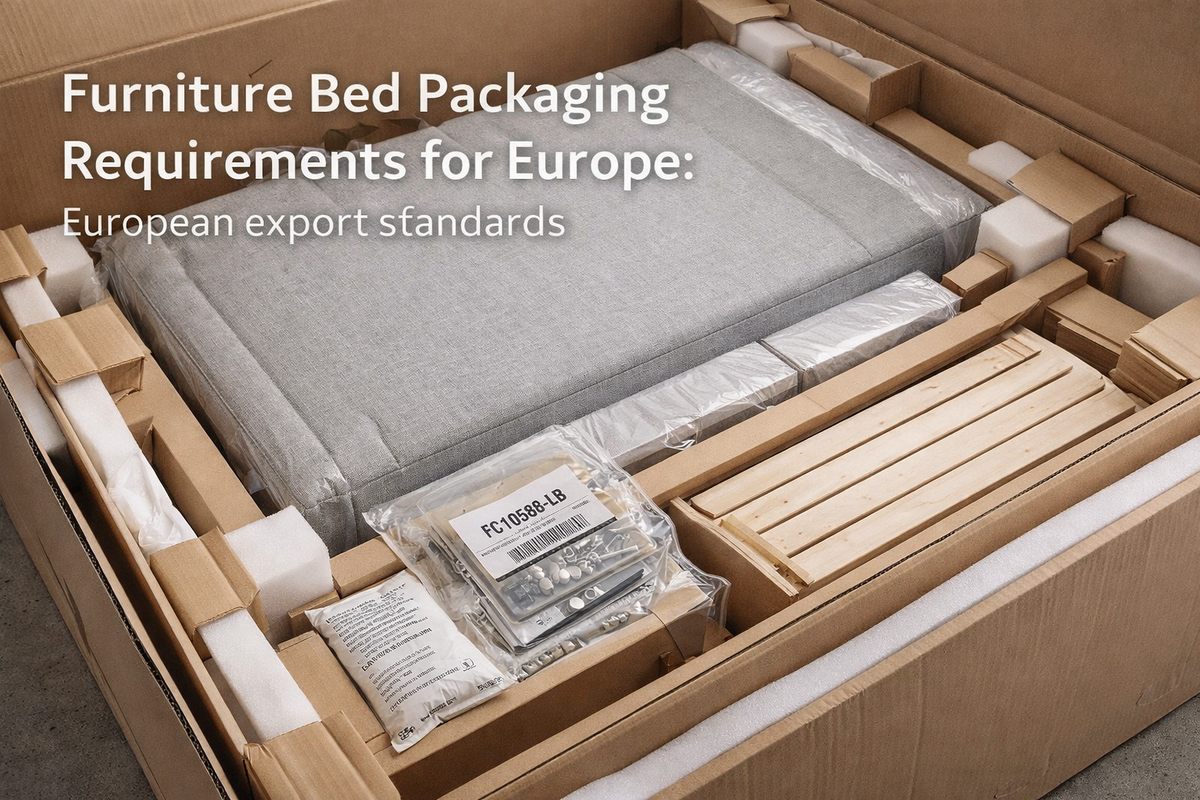
Furniture packaging requirements Europe are most likely to fail on beds: large panels, high part counts, more hardware, and higher sensitivity to moisture and compression damage. This guide translates those risks into practical packaging standards European buyers expect—so exporters can reduce transit damage, limit claims, and keep replenishment stable.
- European wholesalers and retailers importing flat pack beds and upholstered beds
- Independent DTC brands (non-Amazon) needing low return rates and reliable last-mile packaging performance
- Export suppliers building repeatable packaging systems rather than one-off cartons
Why furniture packaging requirements Europe are stricter for beds
Beds concentrate the most common failure modes in residential furniture exports: long panels that chip on edges, cartons that get crushed under stacking pressure, and hardware packs that go missing or get mixed during packing. Unlike smaller upholstered items, bed claims are expensive because replacement parts are large, assembly issues trigger returns, and damage is often discovered late—after warehouse handling or final delivery.
In practice, European buyers judge bed packaging by three outcomes: (1) the bed arrives without edge or surface damage, (2) every carton is complete and traceable, and (3) the packaging performs consistently across repeat orders. If any of those outcomes are unreliable, claim rates rise and the buyer reduces SKU expansion.
Packaging is not a “shipping detail” for beds
For bed programs, packaging is part of the product system. If packaging is designed after the bill of materials is finalized, the exporter ends up chasing problems with extra fillers and last-minute reinforcements. A better approach is to define packaging specs as a controlled document per SKU, then align those specs with QC and change control so performance stays stable.
European logistics increases multi-handling risk
Many European supply chains involve multiple handoffs—port, consolidation, warehouse, regional distribution, and last-mile delivery. Each handoff increases the chance of corner crush, strap damage, and carton abrasion. That is why furniture packaging requirements Europe often emphasize repeatable carton engineering, clear handling cues, and reliable palletization assumptions.
Core bed packaging design principles for Europe
A workable bed packaging design is built on a simple logic: protect the edges and corners first, control compression loads second, and prevent internal movement third. When those three are stable, cosmetic protection and branding become easy rather than fragile.
1) Edge and corner protection (the most common claim driver)
Panels and rails fail at edges because that is where impacts concentrate. Effective protection is not “more padding everywhere.” It is targeted reinforcement at the edges, corners, and contact points where parts touch each other inside the carton. If you export flat pack beds, edge protection should be standardized by panel thickness and carton geometry, not improvised by workers.
- Corner crush control: use consistent corner blocks or reinforced corner construction where stacking is expected.
- Panel edge defense: add edge guards at long edges, not only at corners, especially for headboards and side rails.
- Internal contact control: separate parts that can rub, dent, or chip each other under vibration.
2) Compression performance based on real stacking assumptions
Europe-bound cartons are often stacked in warehouses and during transport. If your compression assumptions are unrealistic, cartons deform, then internal parts take the load and crack or chip. A stable bed packaging design specifies stacking limits, carton orientation, and pallet patterns so compression is managed by the carton structure rather than by the product inside.
- Define maximum stacking height and include it in warehouse handling expectations.
- Standardize pallet patterns so cartons are not load-bearing in unpredictable orientations.
- Audit board grade consistency—variance across batches is a common hidden driver of failures.
3) Internal stability: stop parts from moving under vibration
Transit vibration turns minor gaps into repeated impacts. Internal bracing, dividers, and tight fit are usually more effective than adding soft fillers. For flat pack bed packaging, internal stability should also protect the hardware box and prevent it from tearing through the carton during handling.
Flat pack bed packaging: hardware control and assembly reliability
Flat pack bed packaging fails in two ways: physical damage and assembly failure. Physical damage is visible; assembly failure looks like “missing parts,” “wrong bolts,” or “holes don’t align,” and it creates expensive returns. European buyers treat assembly reliability as a packaging responsibility because kitting and version control happen at packing time.
Hardware kitting and verification
Treat hardware as a controlled sub-assembly. The minimum requirement is a repeatable kitting method with a verification step that is documented and auditable. If the packing line can swap hardware packs between SKUs, claim rates rise quickly.
- One SKU, one kit: label hardware packs with SKU code and revision.
- Seal discipline: verify the kit before sealing the carton, not after.
- Weight sanity check: use a simple expected weight range for the hardware kit to detect missing items.
Instruction version control and part labeling
Even high-quality beds generate returns if assembly instructions are outdated or parts are not labeled consistently. For Europe, where after-sales costs are high, instruction control is not optional. Maintain instruction versions and ensure cartons contain the correct version for that production batch.
- Part labels should be durable and placed where they remain visible during assembly.
- Instruction images must match the current drilling patterns and hardware kit.
- Include a clear “what’s included” checklist to reduce false missing-part claims.
Moisture protection packaging and transit damage prevention
Moisture damage is often misdiagnosed as “material defect” when it is actually a packaging and handling failure. If cartons absorb moisture, panels swell, veneers lift, and upholstered elements can develop odor or staining. Because furniture packaging requirements Europe must perform through seasonal routes, moisture protection packaging should be designed as a controlled process, not a random add-on.
Sealing and barrier strategy
The baseline is consistent sealing: stable tape application, clean carton surfaces, and no unsealed seams. Where routes or seasons create risk, use a barrier strategy appropriate to the product and buyer’s handling environment. Over-packaging can backfire by trapping moisture if the product is packed before it equilibrates.
- Process control: only pack when moisture conditions meet your internal standard.
- Barrier application: apply consistently across batches; inconsistency is worse than a simpler system done well.
- Carton integrity: prevent abrasion and tears that break the barrier during handling.
Desiccants: use only with validation
Desiccants can help on long transits, but only if quantity, placement, and sealing discipline are standardized. If desiccants are thrown in inconsistently, they create a false sense of safety while cartons still absorb moisture. Buyers care more about repeatability than heroic one-off fixes.
Procurement checklist: bed export packaging requirements for Europe
Use this checklist to align packaging, QC, and buyer expectations. It is designed to reduce the most common claim patterns in Europe-bound bed programs, including carton crush, edge damage, hardware loss, and moisture issues. If you sell into Poland, this checklist also supports the risk profile described in the Poland sourcing guide.
| Area | What to define (supplier standard) | What to verify (QC checkpoint) |
|---|---|---|
| SKU-level carton specification | Carton dimensions, weight, protection materials, internal layout, pallet pattern, stacking assumptions | Spec matches production batch; carton build is consistent across lines and shifts |
| Edge/corner protection | Standard corner/edge guards by panel type; separation of contact points | Protection present at all defined locations; no exposed edges in carton |
| Compression resilience | Board grade standard; stacking limit; carton orientation rules | Carton rigidity checks; confirm no deformation under expected stacking |
| Internal stability | Dividers/bracing plan; hardware box anchoring | Shake/vibration sampling; no internal movement causing abrasion or impact |
| Hardware control | SKU-coded kitting method; kit weight range; verification step | Kit matches SKU revision; sealed and traceable; no mixed hardware |
| Instructions & labeling | Instruction versioning; part labeling method; “what’s included” checklist | Correct instruction version in carton; part labels readable during assembly |
| Moisture protection packaging | Sealing standard; barrier use rules; packing condition control | Seals complete; no torn cartons; moisture controls followed and documented |